NTSA Driving Licence in Kenya: Everything You Need to Know Before You Drive
Obtaining an NTSA driving licence is one of the most important steps for anyone who wishes to drive legally in Kenya. Whether you are looking for your first driving licence, planning to renew your licence, applying for a smart driving licence, or...
NTSA Driving Licence in Kenya: Everything You Need to...
SEO-friendly content designed to build trust and stronger driver discovery across Kenya.
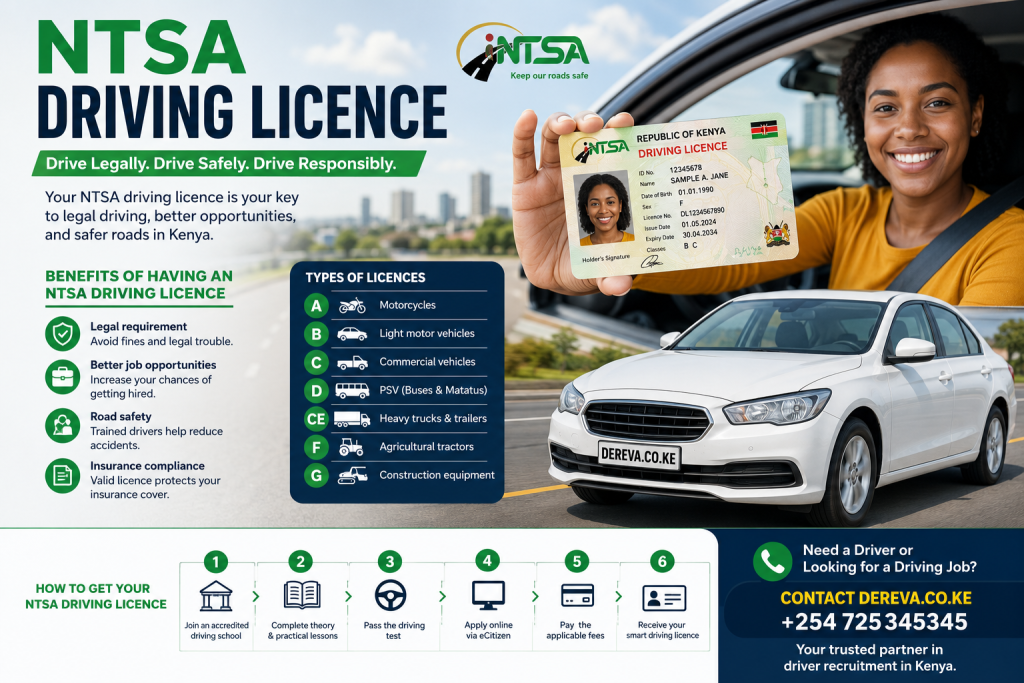
Obtaining an NTSA driving licence is one of the most important steps for anyone who wishes to drive legally in Kenya. Whether you are looking for your first driving licence, planning to renew your licence, applying for a smart driving licence, or searching for professional driving opportunities through Dereva.co.ke, understanding the NTSA driving licence process will save you time and money.
The NTSA driving licence is issued by the National Transport and Safety Authority (NTSA), the government agency responsible for regulating road transport in Kenya. Every driver must possess a valid NTSA driving licence before operating a motor vehicle on Kenyan roads.
At Dereva.co.ke, we connect qualified drivers with employers across Kenya. Having a valid NTSA driving licence significantly increases your chances of getting employed as a personal driver, company driver, school driver, chauffeur, delivery driver, or executive driver.
If you’re searching online for:
- NTSA driving licence application
- NTSA driving licence renewal
- NTSA driving licence requirements
- NTSA driving licence fees
- Smart driving licence Kenya
- How to apply for an NTSA driving licence
- Driving licence replacement Kenya
then this complete guide is for you.
What is an NTSA Driving Licence?
An NTSA driving licence is an official legal document issued by the National Transport and Safety Authority that authorizes an individual to operate specific categories of motor vehicles in Kenya.
Without a valid NTSA driving licence, driving on Kenyan roads is illegal and may lead to:
- Heavy fines
- Arrest
- Court prosecution
- Vehicle impoundment
- Difficulty obtaining insurance claims
A valid NTSA driving licence proves that you have undergone proper driver training, passed the required tests, and understand Kenya’s traffic laws.
Why an NTSA Driving Licence is Important
There are many reasons why every driver should obtain an NTSA driving licence.
1. It is a Legal Requirement
Kenyan traffic laws require every motorist to possess a valid NTSA driving licence before driving.
Driving without an NTSA driving licence is a criminal offence.
2. Better Employment Opportunities
Many employers will not hire drivers without a valid NTSA driving licence.
At Dereva.co.ke, employers regularly search for drivers with valid licences for positions including:
- Personal drivers
- Company drivers
- School transport drivers
- Executive chauffeurs
- Truck drivers
- Taxi drivers
- Delivery drivers
- Long-distance drivers
Having an updated NTSA driving licence makes your profile more attractive to employers.
3. Road Safety
Obtaining an NTSA driving licence means you have completed formal driver training.
Professional training helps drivers understand:
- Traffic signs
- Highway code
- Vehicle control
- Defensive driving
- Road safety
- Emergency handling
This reduces accidents and saves lives.
4. Insurance Compliance
Most insurance companies require drivers to possess a valid NTSA driving licence.
If an accident occurs and your licence has expired, your insurance claim may be rejected.
Types of NTSA Driving Licences
Kenya issues different categories of NTSA driving licence depending on the vehicle you intend to drive.
Some common licence classes include:
Class A
Motorcycles
Suitable for:
- Motorcycle riders
- Bodaboda operators
Class B
Light motor vehicles including:
- Personal cars
- Small vans
- SUVs
Class C
Commercial vehicles
Examples include:
- Pickups
- Delivery vans
- Small trucks
Class D
Passenger Service Vehicles (PSVs)
Includes:
- Matatus
- Buses
- Tour vans
Class CE
Heavy commercial trucks with trailers.
Ideal for:
- Long-distance trucking
- Logistics companies
Class F
Agricultural tractors.
Class G
Construction equipment.
Choosing the correct NTSA driving licence category depends on the vehicle you intend to operate.
Who Can Apply for an NTSA Driving Licence?
You can apply for an NTSA driving licence if you:
- Meet the minimum age requirements
- Have completed training at an approved driving school
- Passed the driving test
- Have a National ID or valid identification
- Meet NTSA requirements
Many Kenyan driving schools now help students complete the entire NTSA driving licence application process.
Requirements for an NTSA Driving Licence
Before applying, you should prepare:
- Kenyan National ID
- KRA PIN
- Passport-size photograph
- Driving school completion certificate
- Passed driving test
- Valid phone number
- eCitizen account
These documents help speed up the NTSA driving licence application process.
How to Apply for an NTSA Driving Licence
The application process has become easier thanks to digital government services.
Step 1
Join an accredited driving school.
Step 2
Complete theoretical lessons.
Topics include:
- Highway Code
- Traffic rules
- Vehicle maintenance
- Road signs
Step 3
Attend practical driving lessons.
Students learn:
- Parking
- Hill starts
- Reversing
- Highway driving
- Emergency braking
Step 4
Take the official driving test.
Passing the test qualifies you for an NTSA driving licence.
Step 5
Submit your application online.
Step 6
Pay the applicable fees.
Step 7
Receive your NTSA driving licence.
Smart NTSA Driving Licence
Kenya has introduced the Smart NTSA driving licence, replacing the older booklet.
The Smart Driving Licence contains:
- Driver information
- Biometric details
- Licence class
- Expiry date
- Digital security features
Benefits include:
- Reduced fraud
- Easy verification
- Faster police checks
- Improved security
- Better record management
Most drivers are encouraged to upgrade to the Smart NTSA driving licence.
NTSA Driving Licence Renewal
Every NTSA driving licence has an expiry period.
Drivers should renew their licence before expiry to avoid penalties.
Reasons to renew include:
- Licence expiry
- Damaged licence
- Lost licence
- Change of personal information
Renewing your NTSA driving licence ensures you remain legally compliant.
Replacing a Lost NTSA Driving Licence
If your NTSA driving licence gets lost, stolen, or damaged, you should replace it immediately.
Typical replacement process includes:
- Reporting the loss
- Applying online
- Paying replacement fees
- Receiving a replacement licence
Never drive without a valid NTSA driving licence.
Common Mistakes When Applying for an NTSA Driving Licence
Many applicants delay their approval because of avoidable mistakes.
Common errors include:
Incomplete Documents
Missing documentation causes delays.
Wrong Personal Information
Always verify:
- Names
- ID number
- Date of birth
- Licence class
Choosing the Wrong Licence Category
Some applicants select the wrong vehicle class.
Always consult your driving school before submitting your NTSA driving licence application.
Delaying Renewal
Expired licences may result in penalties.
Renew your NTSA driving licence early.
Career Opportunities with an NTSA Driving Licence
A valid NTSA driving licence opens the door to numerous employment opportunities across Kenya. As industries continue to grow, the demand for skilled, licensed drivers remains high.
Some of the careers you can pursue include:
- Personal Driver
- Corporate Driver
- School Driver
- Executive Chauffeur
- Taxi Driver
- Ride-hailing Driver
- Delivery Driver
- Courier Driver
- Truck Driver
- Bus Driver
- Tour Driver
- NGO Driver
- Government Driver
- Ambulance Driver (with additional qualifications)
- Logistics Driver
At Dereva.co.ke, we help licensed drivers connect with employers looking for reliable professionals. Creating a profile with a valid NTSA driving licence can increase your visibility and improve your chances of securing rewarding driving jobs across Kenya.
Practical Information Every Driver Should Know
Understanding Driver Responsibilities Beyond Licensing
Getting your driving licence is only the beginning of your journey as a responsible road user. Every licensed driver is expected to uphold high standards of professionalism, safety, and courtesy whenever they are behind the wheel. Driving is a privilege that comes with legal and moral responsibilities.
Drivers should always remain alert, obey traffic signs, respect speed limits, and avoid distractions such as using mobile phones while driving. Defensive driving techniques help reduce accidents by allowing motorists to anticipate hazards before they become emergencies.
Professional drivers are also expected to maintain excellent personal conduct. Employers value drivers who are punctual, respectful, honest, and capable of communicating effectively with passengers, clients, and fellow road users. A positive attitude often makes the difference between keeping a job and losing one.
Vehicle owners also expect drivers to care for company assets by driving responsibly, minimizing unnecessary wear and tear, and reporting mechanical problems before they become major issues.
How to Prepare for a Driving Test
Many learners feel anxious before taking their driving test. Proper preparation greatly improves confidence and increases the likelihood of passing on the first attempt.
Begin by ensuring that you have completed sufficient practical lessons. Practice should cover different road environments, including busy urban roads, highways, residential estates, and rural roads whenever possible.
You should also be comfortable performing essential manoeuvres such as:
- Parallel parking
- Reverse parking
- Three-point turns
- Hill starts
- Emergency stops
- Lane changes
- Overtaking safely
- Proper use of mirrors
- Safe merging into traffic
Understanding road signs is equally important. Spend time revising warning signs, regulatory signs, information signs, and directional signs until you can identify them instantly.
Remain calm during the examination. Listen carefully to the examiner’s instructions, avoid rushing, and remember that safe driving is more important than completing the route quickly.
Tips for New Drivers
Passing your driving test does not mean you have mastered every driving situation. Experience develops over time.
New drivers should:
- Drive within speed limits.
- Leave enough distance between vehicles.
- Avoid unnecessary overtaking.
- Never drive under the influence of alcohol or drugs.
- Avoid driving while tired.
- Keep both hands on the steering wheel whenever possible.
- Stay patient during traffic congestion.
- Learn how weather affects road conditions.
- Continue practising defensive driving.
The first few months of independent driving provide valuable learning opportunities. Confidence should grow alongside experience, never replace it.
Vehicle Maintenance Every Driver Should Know
Being a good driver involves more than operating the vehicle. Basic maintenance knowledge helps prevent breakdowns and improves road safety.
Drivers should regularly inspect:
Tyres
Check tyre pressure regularly and inspect tread depth. Worn tyres reduce grip and increase stopping distance, especially during rainy weather.
Engine Oil
Low engine oil can lead to severe engine damage. Check oil levels according to the manufacturer’s recommendations.
Coolant
The cooling system prevents engine overheating. Drivers should ensure coolant levels remain within recommended limits.
Brake System
Brakes are among the most important safety components. Any unusual sounds or reduced braking performance should be inspected immediately.
Battery
A weak battery can leave you stranded. Regular inspection helps identify corrosion or loose terminals before problems arise.
Lights
Ensure that headlights, brake lights, indicators, and hazard lights function correctly.
Windshield Wipers
Clear visibility is essential, especially during heavy rainfall. Replace worn wiper blades before they become ineffective.
Routine inspections save money by identifying small problems before they become expensive repairs.
Safe Driving During Different Weather Conditions
Kenya experiences varying weather conditions throughout the year, and drivers must adapt accordingly.
Driving During Heavy Rain
Rain significantly reduces tyre grip and visibility. Drivers should reduce speed, switch on headlights, and increase the following distance between vehicles.
Avoid sudden braking or sharp steering movements, as these may cause skidding.
Driving at Night
Night driving requires greater concentration because visibility is reduced.
Drivers should:
- Use appropriate headlights.
- Reduce speed.
- Watch for pedestrians.
- Be cautious around cyclists and motorcycles.
- Avoid looking directly into oncoming headlights.
Driving on Dusty Roads
Many rural roads become extremely dusty during dry seasons.
Reduce speed, maintain a safe distance, and switch on headlights when visibility becomes poor.
Common Causes of Road Accidents
Road accidents rarely occur because of a single factor. Most involve a combination of human error, mechanical failure, and environmental conditions.
Some of the leading causes include:
- Overspeeding
- Reckless overtaking
- Distracted driving
- Drunk driving
- Poor vehicle maintenance
- Driver fatigue
- Ignoring traffic signs
- Inexperienced drivers
- Poor road conditions
- Mechanical failure
Every driver has a role to play in reducing accidents by making responsible decisions every time they travel.
Professional Driving as a Career
Driving has become a respected profession that offers numerous employment opportunities across different industries.
Qualified drivers may work in:
- Corporate organizations
- Government institutions
- Non-governmental organizations
- Schools
- Hospitals
- Hotels
- Tourism companies
- Courier services
- Logistics firms
- Construction companies
- Agricultural businesses
- Private households
Professional drivers often receive additional training in customer service, first aid, vehicle inspection, fuel management, and defensive driving, making them valuable assets to employers.
Building a Successful Career as a Driver
Success in the transport industry depends on more than possessing a licence.
Employers appreciate drivers who demonstrate:
- Reliability
- Honesty
- Good communication skills
- Professional appearance
- Excellent time management
- Respect for traffic laws
- Careful vehicle handling
- Willingness to learn
- Problem-solving abilities
- Positive attitude
Continuous improvement through additional training and certifications can open doors to higher-paying opportunities.
Finding Driving Jobs in Kenya
Many employers now recruit drivers online to simplify the hiring process.
Instead of relying solely on newspaper advertisements or personal referrals, drivers can create professional profiles on recruitment platforms that connect them with verified employers.
When preparing for job applications, ensure that your CV highlights:
- Driving experience
- Vehicle categories operated
- Employment history
- Safety record
- Customer service experience
- Additional certifications
- Languages spoken
- References
Keeping your documents organized allows you to respond quickly whenever suitable opportunities arise.
Why Choose Dereva.co.ke?
Finding trustworthy drivers can be difficult for employers, while qualified drivers often struggle to identify genuine employment opportunities. Dereva.co.ke bridges this gap by providing a dedicated platform designed specifically for driver recruitment in Kenya.
Whether an employer needs a family driver, executive chauffeur, delivery driver, school transport driver, truck operator, or corporate driver, the platform simplifies the recruitment process by connecting businesses with qualified professionals.
For job seekers, Dereva.co.ke provides an opportunity to showcase driving experience, professional qualifications, and employment history to prospective employers across the country.
The platform serves both experienced drivers and individuals seeking to advance their careers within Kenya’s growing transport and logistics sector.
Frequently Asked Questions
Can I drive immediately after passing my driving test?
You should ensure all required licensing processes have been completed before driving independently. Always comply with the applicable legal requirements.
What should I do if I lose my licence?
Report the loss through the appropriate channels and follow the official replacement procedure before continuing to drive.
Can I use one licence for every type of vehicle?
Different vehicle categories require the appropriate driving qualifications. Always ensure you are authorized to operate the specific vehicle you intend to drive.
How often should I inspect my vehicle?
Basic safety inspections should be performed regularly, while comprehensive servicing should follow the manufacturer’s maintenance schedule.
Why is defensive driving important?
Defensive driving helps drivers anticipate hazards, avoid collisions, and protect passengers, pedestrians, and other road users.
The Importance of Continuous Learning for Drivers
Learning does not end once you receive your driving licence. Roads, vehicles, and traffic conditions continue to evolve, making continuous learning an essential part of becoming a skilled and dependable driver. Professional drivers often refresh their knowledge of road safety regulations, attend defensive driving courses, and stay informed about changes in transport policies that may affect their work.
Technology has also transformed the transport industry. Modern vehicles are equipped with advanced safety features such as anti-lock braking systems (ABS), parking sensors, reverse cameras, electronic stability control, and collision warning systems. Understanding how these technologies work enables drivers to use them effectively while recognizing that they are designed to assist—not replace—safe driving practices.
Drivers should also develop good habits when interacting with passengers, clients, and employers. Courtesy, professionalism, and effective communication help build trust and create a positive experience for everyone. For commercial and corporate drivers, maintaining confidentiality, respecting schedules, and presenting a clean, well-maintained vehicle can significantly improve customer satisfaction and future employment opportunities.
Finally, every driver should strive to become an ambassador for road safety. Simple actions such as wearing a seat belt, encouraging passengers to buckle up, avoiding aggressive driving, and setting a good example for younger motorists contribute to safer roads for all. By committing to lifelong learning and responsible driving habits, motorists not only protect themselves but also make a meaningful contribution to reducing accidents and improving the overall driving culture in Kenya.
Conclusion
A driving licence represents more than permission to operate a vehicle—it reflects responsibility, competence, and commitment to road safety. Every journey presents new situations that require patience, sound judgment, and respect for traffic laws. Developing good driving habits from the beginning not only protects lives but also builds a strong reputation for reliability and professionalism.
For those pursuing employment as drivers, continuous learning and maintaining high standards can create long-term career opportunities across many industries. Employers consistently seek individuals who demonstrate safe driving practices, integrity, excellent customer service, and the ability to care for vehicles entrusted to them.
If you are looking for professional driving jobs or if your organization needs experienced and dependable drivers, Dereva.co.ke is ready to help. Our platform connects employers with qualified drivers across Kenya, making recruitment faster, easier, and more reliable.
For enquiries, recruitment assistance, or to learn more about our driver placement services, contact us today:
Dereva.co.ke
Phone: +254 725345345
Whether you are beginning your driving career or searching for your next opportunity, we are committed to helping drivers and employers succeed together on the road.
Ready To Act?
Turn this guide into a stronger Dereva shortlist today.
Use Dereva to browse visible driver profiles, compare trust signals, or join as a driver and get discovered across Kenya.