Dereva Software: Powerful Transport Management System in Kenya, Costs, Benefits & Smart Growth Guide (2026)
Introduction: Understanding Dereva Software in Kenya In Kenya’s fast-changing transport and logistics sector, businesses are shifting from manual coordination to digital systems that improve efficiency, reduce costs, and increase accountability. One of the most important innovations driving this shift is dereva software,...
Dereva Software: Powerful Transport Management System in Kenya, Costs,...
SEO-friendly content designed to build trust and stronger driver discovery across Kenya.
Introduction: Understanding Dereva Software in Kenya
In Kenya’s fast-changing transport and logistics sector, businesses are shifting from manual coordination to digital systems that improve efficiency, reduce costs, and increase accountability. One of the most important innovations driving this shift is dereva software, a structured digital platform that connects drivers, clients, and transport managers into one coordinated ecosystem.
At its core, dereva software is designed to simplify how transport services are requested, assigned, tracked, and paid for. Instead of relying on phone calls, WhatsApp messages, and manual scheduling, businesses now use structured systems that reduce confusion and wasted time.
For example, a company spending KES 45,000 monthly on informal transport coordination often loses around 15–20% in inefficiencies due to delays, double bookings, and fuel wastage. With structured systems like dereva software, these inefficiencies can be significantly reduced through automation and better scheduling.
You can explore more about this ecosystem at https://dereva.co.ke
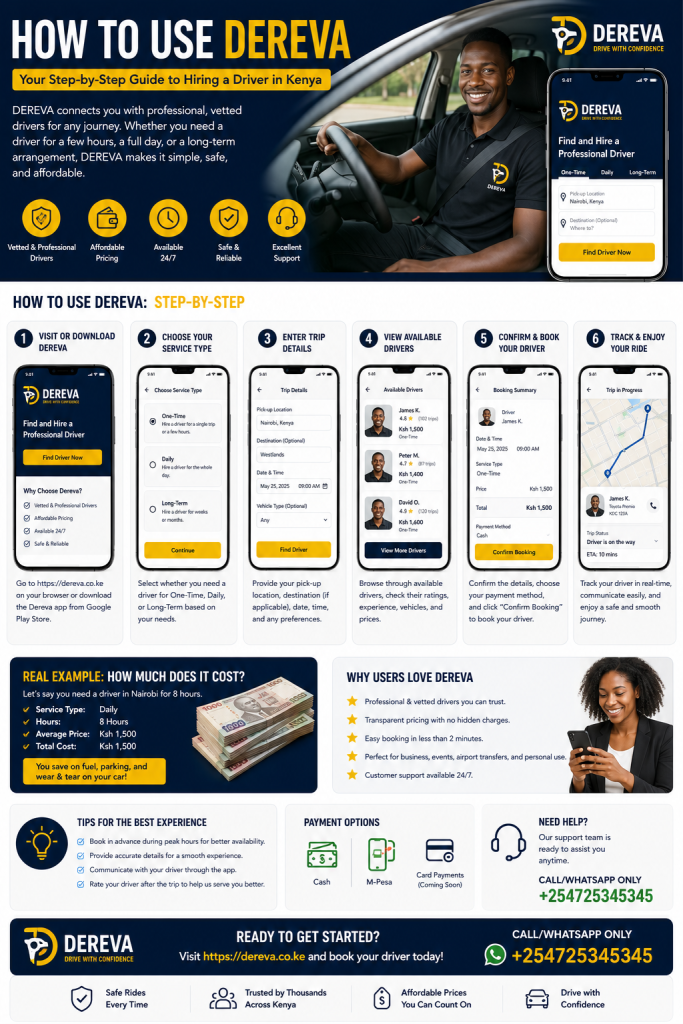
What is Dereva Software and How It Works
Dereva software is a digital transport coordination platform that helps businesses and individuals manage driver requests and vehicle allocation more efficiently. It connects users who need transport with available drivers while maintaining transparency and structured scheduling.
A typical workflow inside dereva software begins when a user requests a ride or delivery. The system automatically assigns a suitable driver based on availability, location, and vehicle type. This reduces idle time and improves operational flow.
In a real Kenyan SME setup, this can replace a manual dispatch system that previously required a full-time coordinator earning about KES 25,000–KES 40,000 monthly. By digitizing this role, businesses reduce administrative overhead while improving response speed.
Learn more about transport digitization trends from the World Bank:
https://www.worldbank.org/en/topic/transport
Key Features of Dereva Software
Modern dereva software platforms are built with several core features that support both drivers and businesses.
One of the most important features is real-time matching, which ensures that available drivers are assigned tasks quickly. This reduces idle time that would otherwise result in lost income or delayed service delivery.
Another important feature is trip tracking. Businesses can monitor every movement in real time, ensuring accountability and reducing disputes. For companies spending over KES 100,000 monthly on logistics, even a 10% improvement in efficiency translates to significant savings.
Payment tracking is also integrated into most systems. Instead of manual reconciliation, the system logs every trip, making it easier to calculate earnings and expenses accurately.
Internal systems like https://dereva.co.ke/platform
also allow businesses to integrate reporting tools for better financial control.
Real Cost Impact of Using Dereva Software
To understand the financial value of dereva software, consider a mid-sized delivery business in Nairobi operating 5 vehicles.
Without a structured system, the business may spend:
- KES 30,000 monthly on coordination inefficiencies
- KES 20,000 in fuel wastage due to poor routing
- KES 15,000 in missed or delayed trips
This totals approximately KES 65,000 in avoidable losses each month.
After implementing dereva software, even a conservative 40% efficiency improvement can save around KES 26,000 monthly. Over a year, this becomes over KES 312,000 in recovered value.
This is why digital transport systems are becoming essential rather than optional in Kenya’s logistics sector.
Insights on logistics optimization can also be found here:
https://www.mckinsey.com/industries/travel-logistics
Benefits for Businesses Using Dereva Software
One of the strongest advantages of dereva software is improved operational efficiency. Businesses no longer rely on manual coordination, which often leads to delays and miscommunication.
Another major benefit is cost control. When transport operations are digitized, every trip is recorded and analyzed. This reduces unnecessary spending and helps managers identify inefficiencies.
For example, a retail distribution company in Nairobi reduced its weekly transport cost from KES 18,000 to KES 14,000 after optimizing routes using structured scheduling. This resulted in monthly savings of KES 16,000.
Improved customer satisfaction is another benefit. Faster response times and reliable deliveries lead to better service quality and stronger customer retention.
Benefits for Drivers Using Dereva Software
Drivers also benefit significantly from dereva software systems. Instead of waiting for random assignments, they receive structured trip allocations based on demand and location.
A driver completing 6 trips daily at an average of KES 400 per trip earns about KES 2,400 per day. Over 26 working days, this becomes approximately KES 62,400 monthly.
With optimized routing and reduced downtime, drivers can complete more trips without increasing working hours, improving overall income stability.
Additionally, digital systems reduce disputes since all trip records are stored in the system, ensuring transparency in payment and assignments.
Risks and Challenges of Dereva Software Adoption
Despite its advantages, dereva software adoption comes with several risks that businesses must manage carefully.
One common challenge is resistance to change. Some drivers and staff may prefer traditional manual systems and may take time to adapt.
Another risk is system dependency. If internet connectivity fails, operations may be temporarily disrupted. In areas with unstable networks, this can affect efficiency.
There is also the risk of poor onboarding. If users are not properly trained, they may underutilize system features, reducing overall effectiveness.
To mitigate these risks, businesses should:
- Provide structured onboarding and training
- Maintain backup communication channels
- Gradually transition from manual to digital systems
- Choose platforms with offline or low-data modes
Is Dereva Software Worth It?
From a business perspective, dereva software is worth adopting for most transport-dependent operations in Kenya.
The financial savings alone can justify the transition. If a business saves even KES 20,000 monthly through improved efficiency, the annual impact exceeds KES 240,000.
However, the real value is not just cost savings. It is also about predictability, accountability, and scalability. Businesses can grow operations without increasing administrative complexity.
For small businesses with low transport demand, the system may feel unnecessary at first. But as operations grow, manual coordination becomes expensive and inefficient.
Industry Outlook: The Future of Transport Systems in Kenya
Kenya’s transport sector is rapidly digitizing. With the rise of gig economy platforms and logistics automation, systems like dereva software are becoming standard tools rather than optional upgrades.
Reports from the Kenya National Bureau of Statistics highlight increasing demand for digital infrastructure in logistics and transport sectors:
https://www.knbs.or.ke
As more businesses adopt structured systems, competition will increasingly depend on efficiency rather than size.
How Dereva Software Improves Transport Planning Efficiency
One of the most overlooked advantages of dereva software is its ability to transform transport planning from a reactive process into a proactive system. In many Kenyan businesses, transport is still managed through last-minute phone calls, informal agreements, and manual scheduling. This leads to inefficiencies that are often invisible but financially significant.
When transport planning is not structured, businesses often experience “hidden losses.” For example, a logistics manager might assume that monthly transport costs are around KES 80,000, but once inefficiencies such as fuel wastage, idle time, and missed deliveries are accounted for, the real cost can exceed KES 100,000.
With dereva software, planning becomes centralized. Requests are logged in real time, drivers are assigned automatically, and routes are optimized based on availability and proximity. This reduces unnecessary movement and improves coordination between teams.
A practical example can be seen in delivery-based SMEs in Nairobi where overlapping routes are common. Instead of sending multiple vehicles to nearby locations separately, the system groups trips logically. This alone can reduce fuel consumption by 10–25%, depending on operational discipline.
For more on logistics optimization principles, refer to:
https://www.investopedia.com/terms/l/logistics.asp
The Role of Dereva Software in Driver Accountability
Accountability is one of the biggest challenges in informal transport systems. Without structured tracking, it becomes difficult to verify trip completion, route efficiency, or time usage. This is where dereva software plays a critical role.
Every trip is recorded digitally, including timestamps, route data, and assignment history. This ensures that both businesses and drivers operate within a transparent system.
For instance, in a manual system, a driver may report completing 8 trips in a day, but there is no reliable way to verify distance, time, or efficiency. With structured systems, each trip is logged automatically, reducing disputes and improving trust between parties.
This transparency also improves payroll accuracy. A company paying drivers a fixed monthly rate of KES 35,000 can instead shift to a performance-based model where earnings reflect actual trips completed. This encourages productivity while maintaining fairness.
Over time, businesses using structured systems report fewer conflicts and improved operational discipline because expectations are clearly defined and tracked.
Operational Scaling Using Dereva Software
Scaling a transport-dependent business without proper systems often leads to breakdowns in coordination. As demand increases, manual systems become overwhelmed, leading to delays and customer dissatisfaction.
Dereva software solves this by allowing businesses to scale operations without proportionally increasing administrative workload. Instead of hiring additional coordinators, businesses can rely on automated assignment systems.
For example, a company handling 50 daily deliveries might manage operations with one dispatcher. If demand doubles to 100 deliveries per day, a manual system would typically require at least one additional staff member earning around KES 30,000 monthly. With a digital system, this additional cost can often be avoided.
This is a key reason why digital transport systems are becoming essential in logistics-heavy industries such as e-commerce, courier services, and field sales operations.
A deeper analysis of scaling efficiency can be found at:
https://hbr.org/2017/07/the-economics-of-scale-in-digital-businesses
Customer Experience Improvements Through Dereva Software
Customer experience in transport and delivery services is directly influenced by speed, reliability, and communication. When operations are unstructured, customers often face delays without updates or explanations.
With dereva software, customers benefit from improved communication because trip status updates are automated. This reduces uncertainty and improves satisfaction.
For example, instead of a customer waiting without updates for a delivery scheduled at 2:00 PM, the system can provide real-time tracking or status notifications. This improves trust and reduces support calls.
Businesses that improve delivery transparency often see fewer complaints and higher repeat customer rates. Even a small 5–10% improvement in customer retention can have a significant revenue impact over time.
Cost Optimization Strategies Enabled by Dereva Software
Beyond operational improvements, dereva software also enables businesses to implement cost optimization strategies that were previously difficult to execute manually.
One of these strategies is route consolidation. Instead of dispatching vehicles for individual trips, businesses can group nearby deliveries into a single optimized route. This reduces fuel consumption and increases trip efficiency.
Another strategy is demand-based scheduling. Businesses can analyze peak demand periods and allocate drivers accordingly. This prevents overstaffing during low-demand hours and understaffing during peak periods.
A transport company spending KES 120,000 monthly on fuel and logistics coordination could realistically reduce costs by 12–18% through better route optimization alone. This translates into monthly savings of KES 14,400 to KES 21,600.
Internal Data Visibility and Business Intelligence
One of the most powerful but underutilized benefits of dereva software is data visibility. Every trip, cost, and driver activity is recorded in the system, creating a dataset that businesses can analyze for decision-making.
Instead of guessing operational performance, managers can review actual data trends such as peak usage times, high-cost routes, and driver productivity levels.
For example, a business might discover that 30% of its transport costs come from only 15% of routes. This insight allows for targeted optimization instead of broad cost-cutting measures.
Data-driven decision-making is now considered a core competitive advantage in modern logistics operations, as highlighted by:
https://www2.deloitte.com/global/en/pages/operations/articles/supply-chain-analytics.html
Why Businesses Are Moving Away from Manual Transport Systems
The shift from manual coordination to structured digital systems is not just a trend—it is a necessity driven by rising operational complexity.
Manual systems struggle to handle scale, accuracy, and transparency simultaneously. As businesses grow, these limitations become more costly and difficult to manage.
In contrast, dereva software provides a structured environment where operations remain consistent regardless of scale. This consistency is critical for businesses that want to expand without losing control over costs or service quality.
Long-Term Sustainability and Business Growth with Dereva Software
As transport-based businesses mature, sustainability becomes just as important as short-term efficiency. Many companies in Kenya struggle not because they lack demand, but because their internal systems cannot support consistent service delivery over time. This is where structured platforms like dereva software become essential for long-term stability.
One of the biggest sustainability advantages is operational consistency. When transport coordination depends on human memory or informal communication, performance tends to fluctuate. Busy days may be handled well, while peak demand periods often lead to confusion and delays. Over time, this inconsistency damages customer trust and limits growth potential.
With a structured system, every process is standardized. Requests follow a predictable flow, drivers are assigned based on availability logic, and all activities are logged automatically. This reduces dependence on individual decision-making and ensures that operations remain stable even when staff changes occur.
Another long-term benefit is reduced management fatigue. In traditional systems, managers spend a significant portion of their time resolving scheduling conflicts, tracking drivers, and handling complaints. In many small and mid-sized Kenyan businesses, this can take up 2–4 hours daily, which translates into a hidden labor cost of over KES 20,000–KES 40,000 monthly depending on workload and staffing structure.
By automating these processes, dereva software allows managers to focus on strategic growth activities such as expanding client acquisition, improving service quality, and optimizing pricing models instead of constantly troubleshooting operational issues.
Workforce Productivity Improvements
Another important dimension of dereva software is its impact on workforce productivity. When transport operations are disorganized, employees often experience delays that affect their ability to complete assigned tasks efficiently. This is especially common in field sales, delivery services, and maintenance operations.
For example, a field technician scheduled to complete five client visits in a day may only manage three due to transport delays or poor coordination. This results in lost productivity that directly affects revenue generation.
With structured scheduling, travel time is reduced and optimized, allowing employees to complete more tasks within the same working hours. Even a 15–20% improvement in daily task completion can significantly increase monthly output without increasing labor costs.
This improvement compounds over time, especially in businesses that rely heavily on field operations. Instead of hiring additional staff to increase output, companies can simply optimize existing workflows using structured transport coordination.
Strategic Competitive Advantage in the Kenyan Market
As more businesses adopt digital systems, competition is increasingly shifting from basic service delivery to operational efficiency. Companies that can deliver faster, more reliably, and at lower cost gain a significant advantage in the market.
Dereva software contributes to this advantage by reducing friction in transport operations. Faster dispatch times, fewer delays, and improved route planning all contribute to a smoother customer experience.
In competitive sectors such as e-commerce, logistics, and on-demand services, even small improvements in delivery speed can influence customer retention. Businesses that consistently deliver on time are more likely to receive repeat orders and positive referrals.
Over time, this creates a compounding effect where operational efficiency directly influences revenue growth and market positioning.
Internal Ecosystem Advantage
Businesses using https://dereva.co.ke
also benefit from integrated internal tools that support broader operational needs. These tools help unify transport management with other business functions such as scheduling, reporting, and workforce coordination.
This integration reduces the need for multiple disconnected systems, which often create data silos and inefficiencies.
Practical Example of Business Transformation
Consider a courier company in Nairobi handling 120 deliveries per week. Before using dereva software, delays and miscommunication caused around 15 failed deliveries weekly, costing approximately KES 500 per failed trip.
That translates to KES 7,500 weekly losses or KES 30,000 monthly.
After adopting a structured system, failed deliveries reduced by 60%, saving approximately KES 18,000 monthly.
This is a realistic example of how structured systems improve operational performance.
Conclusion: The Strategic Value of Dereva Software
The shift toward digital transport coordination is no longer optional in Kenya’s competitive business environment. Dereva software provides a structured, efficient, and scalable solution for managing drivers and transport operations.
While challenges such as adoption and connectivity exist, the long-term benefits in cost savings, efficiency, and accountability make it a strong investment for businesses of all sizes.
Organizations that adopt early gain a competitive advantage through better planning, reduced costs, and improved service delivery.
To explore how your business can benefit, visit https://dereva.co.ke
Ready To Act?
Turn this guide into a stronger Dereva shortlist today.
Use Dereva to browse visible driver profiles, compare trust signals, or join as a driver and get discovered across Kenya.