Driving Services Like Uber: 15 Powerful Alternatives and Opportunities in Kenya (2026)
Driving Services Like Uber Technology has transformed the way people move around cities. Instead of waiting by the roadside for a taxi or calling multiple transport companies, passengers can now book rides within minutes using mobile applications. The popularity of driving services...
Driving Services Like Uber: 15 Powerful Alternatives and Opportunities...
SEO-friendly content designed to build trust and stronger driver discovery across Kenya.
Table of Contents
ToggleDriving Services Like Uber
Technology has transformed the way people move around cities. Instead of waiting by the roadside for a taxi or calling multiple transport companies, passengers can now book rides within minutes using mobile applications. The popularity of driving services like Uber has changed urban transportation across Kenya by making travel more convenient, transparent, and accessible.
In major cities such as Nairobi, Mombasa, Kisumu, Nakuru, Eldoret, and Thika, thousands of passengers rely on app-based transport every day. Whether travelling to work, attending meetings, visiting the airport, or returning home late at night, digital ride-hailing services have become part of everyday life.
The growth of driving services like Uber has also created employment opportunities for thousands of professional drivers. Some operate their own vehicles, while others drive cars owned by investors or fleet management companies. This flexibility allows individuals to earn income while providing reliable transport services to passengers.
However, ride-hailing is only one part of Kenya’s broader transport industry. Many organizations also require professional chauffeurs, delivery drivers, executive drivers, school transport drivers, and temporary replacement drivers. Platforms such as Dereva complement the transport ecosystem by connecting verified professional drivers with employers seeking qualified driving professionals beyond traditional ride-hailing.
Whether you are considering becoming a professional driver, hiring one, or simply understanding how driving services like Uber operate, this guide explores the opportunities, challenges, costs, and future of digital transport in Kenya.
What Are Driving Services Like Uber?
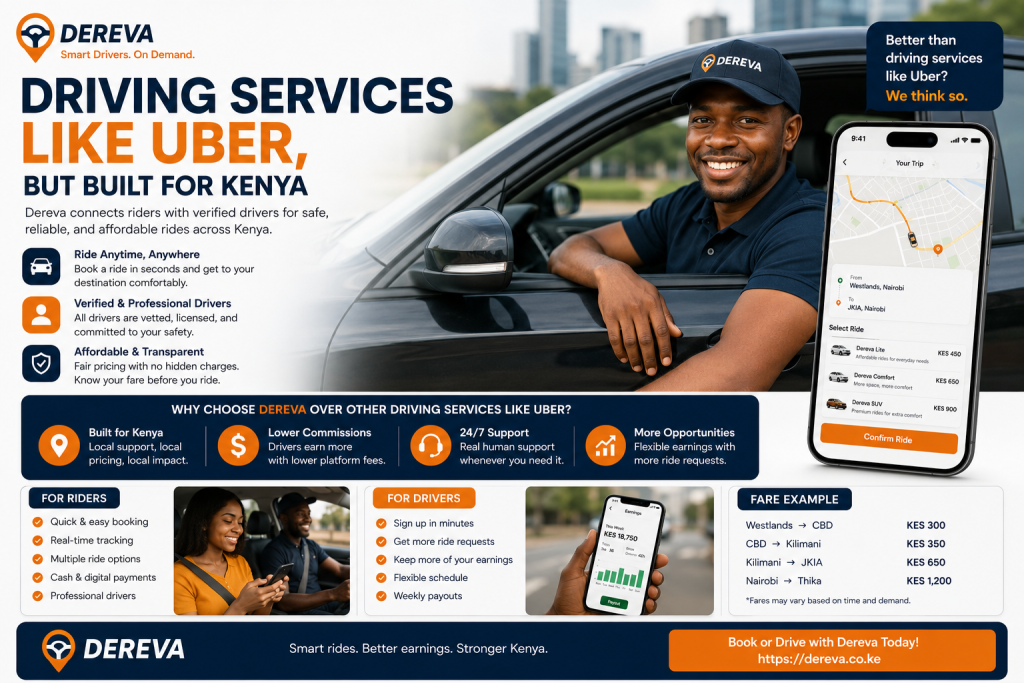
Driving services like Uber refer to app-based transportation platforms that connect passengers with nearby drivers through mobile applications.
Instead of calling a taxi dispatch office, passengers use smartphone apps to request rides, receive fare estimates, track driver arrival, and complete payments digitally or in cash depending on platform policies.
Drivers receive ride requests through dedicated applications and choose whether to accept available trips.
Most ride-hailing platforms calculate fares automatically using factors such as travel distance, estimated duration, demand levels, and booking fees.
Although Uber introduced this model globally, numerous alternatives now operate across Kenya and Africa.
The success of driving services like Uber has encouraged innovation throughout the transport sector, leading to improved convenience, digital payments, driver ratings, GPS navigation, and customer feedback systems.
Why Driving Services Like Uber Continue to Grow
Several factors explain the increasing popularity of driving services like Uber.
The first is convenience.
Passengers no longer need to search physically for available taxis.
Instead, they can book transport from almost any location using their smartphones.
Digital navigation also improves efficiency.
Drivers receive accurate pickup locations while passengers can monitor vehicle arrival in real time.
Transparent pricing represents another major advantage.
Many ride-hailing platforms estimate fares before journeys begin, helping passengers make informed decisions.
Cashless payment options further improve convenience for customers who prefer electronic transactions.
Urbanization has also contributed to market growth.
As Kenyan cities continue expanding, demand for flexible transportation services increases accordingly.
Business travellers, students, tourists, and families all appreciate reliable transport that can be requested on demand.
These combined factors continue driving adoption of driving services like Uber throughout Kenya.
Popular Driving Services Like Uber in Kenya
Although Uber remains one of the best-known ride-hailing companies, several alternatives operate successfully within Kenya.
Bolt has established a significant presence across multiple cities by offering affordable ride options and delivery services.
Little Cab, developed specifically for the Kenyan market, remains popular among both passengers and drivers.
Faras provides another locally recognized ride-hailing platform while supporting taxi services and logistics.
In addition to these applications, traditional taxi companies continue serving corporate clients, hotels, airports, and executive transport markets.
Many organizations also maintain internal transport departments employing dedicated professional drivers instead of relying entirely on ride-hailing platforms.
The continued expansion of driving services like Uber demonstrates that passengers value convenience while professional drivers increasingly seek flexible employment opportunities.
Opportunities for Professional Drivers
The growth of driving services like Uber has significantly expanded employment opportunities within Kenya’s transport industry.
Many drivers begin by operating ride-hailing vehicles before advancing into executive chauffeur services, corporate transport, tourism, logistics, or fleet management.
Others combine multiple income sources.
For example, a driver may accept ride-hailing requests during weekdays while providing airport transfers, private chauffeur services, or event transportation during weekends.
Professional driving also extends beyond passenger transport.
Delivery services, courier operations, medical logistics, school transportation, tourism companies, NGOs, and corporate organizations continue recruiting experienced drivers throughout the year.
Platforms such as Dereva help these employers discover verified drivers whose experience extends beyond ride-hailing alone.
As transport needs diversify, qualified professional drivers gain access to a wider range of career opportunities.
Benefits for Passengers
Passengers enjoy several important advantages when using driving services like Uber.
Convenience remains the most obvious benefit.
Instead of searching for transportation manually, customers request rides through mobile applications from homes, offices, shopping centres, airports, or hotels.
Estimated arrival times improve planning while digital navigation reduces confusion regarding pickup locations.
Passengers also appreciate transparent pricing because estimated fares appear before confirming bookings.
Rating systems encourage professionalism by allowing passengers and drivers to review each other after completed trips.
Safety features such as trip sharing, driver identification, GPS tracking, and emergency support options further enhance user confidence.
Competition among multiple ride-hailing platforms also encourages service improvements, benefiting passengers through better pricing, vehicle quality, and customer support.
Choosing the Right Driving Service
Selecting between different driving services like Uber depends on several considerations.
Passengers should compare availability within their location.
Some platforms operate extensively in Nairobi while maintaining limited coverage elsewhere.
Pricing also varies depending on demand, vehicle category, booking fees, and promotional offers.
Customer service represents another important consideration.
Platforms that respond quickly to complaints generally maintain stronger reputations.
Vehicle options may also influence decisions.
Some passengers require executive vehicles while others prioritize affordability.
Business travellers may prefer professional chauffeurs for corporate meetings instead of ordinary ride-hailing services.
Reading customer reviews provides additional insight into reliability and service quality before making travel decisions.
Understanding Driver Requirements
Individuals interested in joining driving services like Uber should understand that professional driving requires more than simply owning a vehicle.
Drivers generally require valid driving licences, appropriate insurance, compliant vehicles, smartphones, and familiarity with platform requirements.
Professional customer service also plays a major role.
Passengers expect punctuality, politeness, safe driving, and vehicle cleanliness.
Drivers who consistently deliver excellent service often receive stronger ratings, increasing future booking opportunities.
Understanding local roads also remains valuable.
Knowledge of traffic patterns, alternative routes, airport procedures, and popular destinations helps improve passenger satisfaction while reducing unnecessary delays.
For drivers seeking opportunities beyond ride-hailing, maintaining a professional profile through platforms like Dereva increases visibility among employers requiring experienced transport professionals.
Common Challenges
Despite their popularity, driving services like Uber also present several challenges.
Traffic congestion remains one of the biggest obstacles in major cities.
Long travel times may reduce the number of completed trips within a working day.
Vehicle maintenance represents another significant responsibility.
Regular servicing, tyres, insurance, licensing, and fuel all contribute to operating expenses.
Drivers working with investor-owned vehicles must also understand revenue-sharing agreements before beginning operations.
Competition has increased substantially as more drivers join digital platforms.
Maintaining excellent customer ratings, professionalism, and reliability therefore becomes increasingly important.
Passengers may occasionally experience surge pricing during periods of exceptionally high demand.
Although these challenges exist, many professional drivers continue building sustainable careers through ride-hailing while expanding into broader transport opportunities available across Kenya.
Comparing Driving Services Like Uber with Private Driver Services
While driving services like Uber are excellent for on-demand transport, they are not always the best solution for every journey. Many businesses, families, and organizations require a dedicated driver rather than booking individual trips throughout the day.
For example, a company that expects an executive to attend six meetings across Nairobi may spend KES 800–1,500 per trip on ride-hailing depending on distance and demand. If six trips average KES 1,000 each, the transport cost reaches KES 6,000 in one day. Over a 22-working-day month, that amounts to approximately KES 132,000. In some situations, hiring a dedicated driver for a company vehicle may provide better value while offering greater flexibility.
Similarly, families needing daily school runs often prefer a dedicated driver because the same professional becomes familiar with the children’s schedule, preferred routes, and household requirements.
Platforms such as Dereva help employers find personal drivers, executive chauffeurs, family drivers, and temporary replacement drivers who meet specific transport needs rather than relying solely on ride-hailing services.
Why Dereva Complements Driving Services Like Uber
Many people assume that driving services like Uber and professional driver marketplaces compete directly.
In reality, they solve different problems.
Ride-hailing platforms connect passengers with available drivers for individual trips.
Dereva focuses on connecting employers, families, fleet owners, logistics companies, and organizations with professional drivers for longer-term or specialized assignments.
For example, if a logistics company suddenly requires five delivery drivers, searching through a ride-hailing app is not practical. Instead, employers can browse verified driver profiles, compare experience, and contact suitable candidates directly through Dereva.
Businesses looking for recruitment advice can also explore the Driver Discovery Platform guide or the Client Guide to Contacting Drivers on Dereva for practical hiring recommendations.
Safety Tips for Passengers and Drivers
Whether using driving services like Uber or hiring a private driver, safety should remain the highest priority.
Passengers should always confirm the vehicle registration details before entering the car, share trip details with trusted family members when travelling late at night, and use platforms that provide transparent driver information.
Drivers should prioritize vehicle maintenance, obey traffic laws, avoid distracted driving, and maintain professional communication with passengers.
Road safety information published by the National Transport and Safety Authority (NTSA) provides useful guidance for both motorists and employers responsible for transport operations.
Companies managing larger fleets may also benefit from the Motor Vehicle Safety guidance from OSHA, while defensive driving practices are covered by AA Kenya.
Challenges Facing Driving Services Like Uber
Although driving services like Uber have transformed urban transport, several challenges remain.
Traffic congestion in Nairobi, Mombasa, and other growing cities increases journey times and fuel consumption.
Vehicle maintenance costs continue rising due to fuel prices, servicing requirements, tyres, insurance, and licensing expenses.
Competition has also intensified.
As more drivers join ride-hailing platforms, drivers may spend longer waiting between trips, particularly during off-peak hours.
Passengers occasionally encounter surge pricing during periods of exceptionally high demand, public holidays, or severe weather.
Despite these challenges, many professional drivers diversify their income by combining ride-hailing with airport transfers, executive chauffeur work, delivery services, and corporate transport.
Risk Section: What Can Go Wrong?
Working with driving services like Uber or hiring independent drivers involves certain risks.
Drivers who fail to maintain their vehicles may experience unexpected repair costs that interrupt their income.
For example, replacing a set of tyres may cost KES 30,000–60,000, while major engine or transmission repairs can cost substantially more depending on the vehicle.
Passengers also face risks if they use unverified transport providers instead of established platforms.
Businesses hiring drivers without checking references, licence categories, or previous experience may experience poor service or operational disruptions.
These risks can be reduced by:
- Verifying driver qualifications.
- Maintaining vehicles regularly.
- Using reputable transport platforms.
- Conducting interviews before long-term hiring.
- Reviewing previous work experience and references.
Using specialized recruitment platforms such as Dereva helps employers compare professional drivers before making hiring decisions.
Building a Long-Term Career Beyond Driving Services Like Uber
One important trend in Kenya’s transport industry is that many drivers who start with driving services like Uber eventually expand into other professional driving opportunities. Ride-hailing provides valuable experience in customer service, navigation, time management, and vehicle care, but it can also serve as a stepping stone toward higher-paying and more stable contracts.
For example, a driver who consistently maintains excellent passenger ratings may later qualify for executive chauffeur work. Corporate clients often look for drivers with proven professionalism, punctuality, and communication skills. Similarly, tourism companies prefer drivers who understand customer service and can manage long-distance travel comfortably. By treating every ride as a professional assignment, drivers can build a reputation that opens doors beyond ordinary ride-hailing.
Another growing opportunity involves airport transfers and private bookings. A driver operating on driving services like Uber may receive referrals from satisfied passengers who later need transport for business meetings, family events, or visitors arriving from abroad. If a driver completes just four private airport transfers per week at an average of KES 3,500 each, that adds approximately KES 14,000 per week or KES 56,000 per month before fuel and operating costs. While actual earnings vary depending on location and demand, this example shows why many experienced drivers diversify their services instead of relying on a single platform.
Fleet owners also play an important role in the ecosystem surrounding driving services like Uber. Some investors purchase vehicles specifically for transport operations and hire professional drivers to manage them. Success in this model depends heavily on selecting reliable drivers, setting clear revenue-sharing agreements, and maintaining vehicles properly. Platforms such as Dereva help fleet owners identify experienced drivers who may be suitable for long-term transport operations rather than searching through informal referrals alone.
Passengers benefit from this professionalization as well. As competition increases among driving services like Uber, drivers who maintain clean vehicles, communicate politely, arrive on time, and drive safely tend to receive stronger ratings and more repeat business. This encourages higher service standards across the industry.
Technology is also likely to improve the passenger experience further. Better GPS accuracy, digital payments, safety features, and trip tracking continue to make driving services like Uber more convenient. At the same time, specialized driver marketplaces are making it easier for employers to find dedicated chauffeurs, delivery drivers, executive drivers, and temporary replacement drivers when ride-hailing alone is not sufficient.
Ultimately, the transport industry in Kenya is becoming more diverse. Driving services like Uber remain an important part of urban mobility, but they are increasingly connected to a broader professional driving market that includes corporate transport, logistics, tourism, family driving, and executive chauffeur services. Drivers who build strong reputations, maintain their vehicles, and use platforms such as Dereva to increase their visibility are often better positioned to access these wider opportunities and create a more sustainable long-term career in the transport sector.
Is It Worth Working with Driving Services Like Uber?
For many professional drivers, yes.
Driving services like Uber offer flexibility, access to passengers, and an opportunity to generate income without traditional employment.
However, relying exclusively on ride-hailing may not always provide stable earnings throughout the year.
Many successful drivers build multiple income streams by combining ride-hailing with executive chauffeur services, corporate driving, airport transfers, school transport, logistics, and private contracts.
Likewise, businesses that require drivers regularly often find greater value in hiring dedicated professionals instead of booking individual rides every day.
The right choice depends on your goals, transport needs, and expected travel frequency.
Frequently Asked Questions
1. What are driving services like Uber?
They are app-based transport platforms that connect passengers with nearby drivers through mobile applications.
2. Can I work full-time using driving services like Uber?
Yes, although many drivers increase their income by combining ride-hailing with other professional driving opportunities.
3. Where can businesses find professional drivers?
Businesses can search verified driver profiles through Dereva, which specializes in connecting employers with professional drivers across Kenya.
4. Is Dereva only for ride-hailing drivers?
No. Dereva supports executive chauffeurs, family drivers, corporate drivers, delivery drivers, truck drivers, temporary replacement drivers, and many other driver categories.
5. Where can I learn more about professional driver hiring?
Helpful resources include the Dereva Driver Services Blog, the Driver Discovery Platform guide, and the Executive Driver hiring guide.
Final Thoughts
The popularity of driving services like Uber has permanently changed how people travel in Kenya. Digital platforms have made transport more convenient, created employment opportunities for thousands of drivers, and improved customer choice.
At the same time, many transport needs extend beyond traditional ride-hailing. Families, companies, logistics firms, hotels, NGOs, and tour operators often require dedicated professional drivers for long-term or specialized assignments.
If you are looking to hire a qualified driver or showcase your driving experience to potential employers, Dereva offers a dedicated marketplace built specifically for Kenya’s professional driver community. You can search driver profiles, compare experience, and connect directly with suitable candidates while reducing the time and uncertainty involved in traditional recruitment.

Ready To Act?
Turn this guide into a stronger Dereva shortlist today.
Use Dereva to browse visible driver profiles, compare trust signals, or join as a driver and get discovered across Kenya.